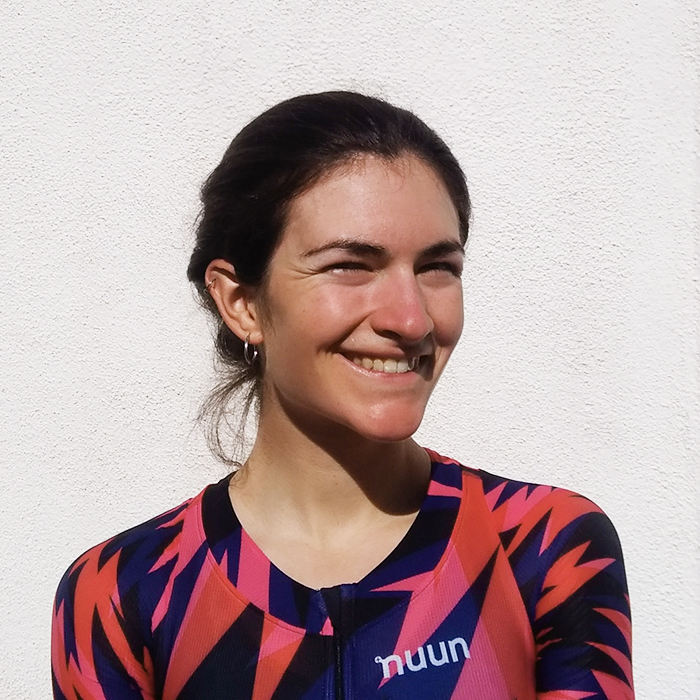
Hailing from France, Cécile Lejeune is a former rider in our Under 23 Development squad and Elite team, Coalition Alpha (formerly known as Canyon Esports).
Early on, we knew that she had a talent for racing and was able to perform at a level beyond her years. It was hard to stand out in our Dev team, as it was packed with young talent, with the likes of Michał Kaminski on the men's side, and Maud Oudemann, who would go on to win Zwift Academy and join the World Tour. Yet with plenty of consistent performances, it wasn't long until she was promoted to become a permanent member of the elite squad.
Cécile left the team to focus on road racing in Europe before making the move to the US to be closer to her husband. Without the same access to a vibrant road scene, it wasn’t long until she was making the transition to gravel. And that transition could not be going better!
In 2025, Cécile had some strong performances at some of the biggest races in gravel. However, it was her 5th place at UNBOUND that really showed what she was made of. Over the 326 km route, she was able to stick with the big guns all the way to the finish. Clearly, others were taking notice too, and she would start 2026 on a new team: Trek Driftless.
This year, she has repeated her performances at both the Sea Otter Classic and Belgian Waffle Ride Arizona, and since this interview, has won the Belgian Waffle Ride California – her first major win in gravel.
Given her history with the team and her successful transition from racing indoors to out in the dirt, I wanted to find out how you go about making that leap and if there is anything we can learn from her success. We covered a wide range of topics, and the hour-long interview has been condensed for this written piece. I hope you enjoy!
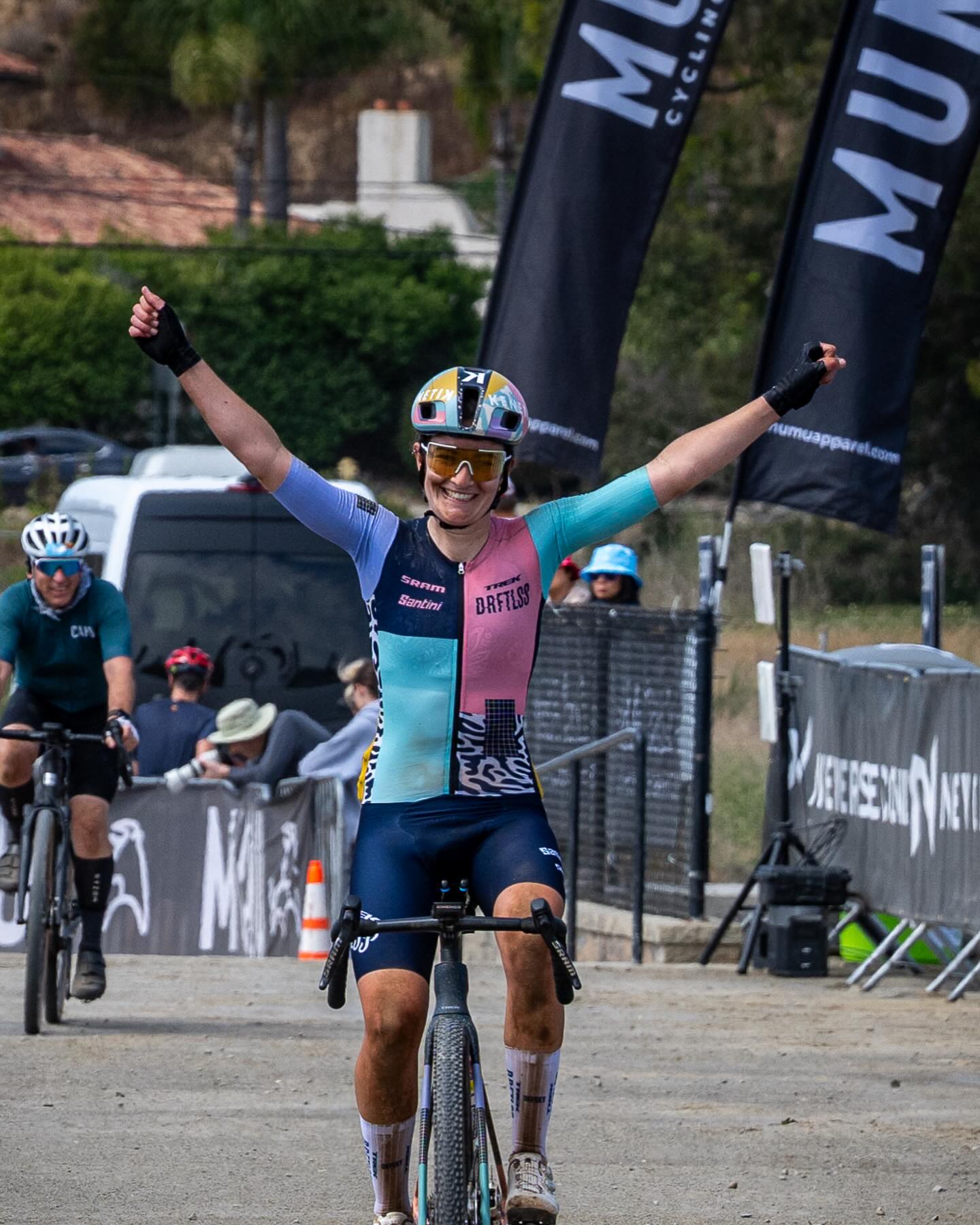 Photo: Dan Hughes
Chatting with Cécile Lejeune
Rhys: Even though it’s been several years since you raced with the team, I do occasionally send you a message to see if you want to come back. But I haven’t quite convinced you yet!
Cécile: It's a testament to the weather here. I don't even own a direct drive trainer anymore. I would absolutely be riding Zwift, were I to live anywhere else that had anything remotely close to a winter. I don't really like riding my bike outside in the rain. So maybe if we move one day, I'll be back training on Zwift.
Well, the gravel scene seems to be pretty much the perfect sport for you from what I've seen. I was watching the women's race at UNBOUND and I was just shouting at the TV cheering you on! And now you’ve started 2026 with a new team: Trek Driftless. So and Eracer to a Gravel Pro – it’s a real thing!
It was exciting for me to be up there. Yeah, in a discipline that's the complete opposite of e-racing
The road less travelled: eracing to gravel
What led you to gravel? For example, had you always planned to do the Oregon Trail Gravel, or you felt like having a go and that's where you fell in love with gravel racing?
So in 2023, I was on the Spanish Continental Team, Massi Tactic, and I spent most of the season in Spain racing a lot of the big UCI Spanish races. I really didn't enjoy racing on the road that much that year. It was my first year with the big girls in the big races, and maybe had I pursued it a bit longer, I would have got used to it. But I wasn't enjoying it – I wasn't with my family or, more importantly, my husband. We were married at that point and it just didn't feel right, so I flew back to the US.
I stayed here, got my green card and from then on, I thought, well… what do I want my cycling career to look like from now? I was able to join a domestic elite team here and there are quite a few road races that looked interesting to me: Redlands, Tour of the Gila, etc.
If you race on the road in the US, and want to grow from it, you have to go to Europe because that's where all the races are. And that's the natural progression. Having a career in road racing in the United States is fairly limited. I’d just fled Europe, so that's what I didn't want to do, both because of the type of racing but also because of the lifestyle. So I looked at my other options. I could have done some track racing, but at that time, there was no track here and it's not really something that suits me very well anyway.
I had heard that gravel racing was developing quite rapidly, and I thought it's something that could suit me physiologically. Plus, you also get to spend a lot of time in nature on gravel roads as opposed to paved roads. Now, the number of gravel races in the United States is increasing year after year.
And how do the communities differ?
The community around gravel is really different from any other discipline. What you get at races is what I wanted to find in sport again. It's a mix of amateurs and pro racers. You get to see a bit of everything. It's a bit of a party.
I tried Belgian Waffle Ride, and I really enjoyed it. Then I went to Oregon Trail, which had part of the course on the road. I loved the effort, which is just ‘on’ the whole day. It's not as punchy as road racing. Yeah, it's really the race that showed me that this was what I wanted to do. So that’s when I committed to Gravel.
I applied to the Lifetime Grand Prix, which is probably the biggest gravel series in the world. It's six races – three gravel, three mountain bike and all in different States. I got in.
You got in, and you got fifth at UNBOUND on your first time racing it. And now you’re on a professional gravel team for 2026! Chapeau.
I checked out the Trek Driftless website and I noticed you had quite a long interview there which was really nice to read. But I noticed that there was no mention of e-racing. And so I just wanted to ask, are you ashamed of your e-racing history? :)
Am I ashamed? No, I loved eracing. Maybe they cut it out. I don't know. No, I think it's a great tool, and I think I would definitely be back on Zwift and back racing if, as I said, if I lived anywhere else. But I just have the privilege of living somewhere where I can ride outside almost every day of the year. I would proudly talk about it in my history if anyone were to ask me.
A brush with reality and overcoming adversity
When I was reading your interview after you joined the Trek team, you mentioned previously suffering from an eating disorder, which really surprised me. But then it is something that comes up in eracing with both men and women, both at the elite but also the community level. Do you mind sharing your story and how you overcame it?
Yeah, so it's something that I have enough distance from now that I can talk about it. Maybe a few years ago, I wouldn't have been able to. It affected me the most when I was still in my teens and doing both running and triathlon. And something that comes along with a lot of addictions and eating disorders – even though someone tells you it's not good for you, you keep doing it anyway because either you don't believe them, or you do see the consequences, but you prefer your way of doing things.
Doctors and people whom I should have trusted told me it was bad for me to be eating this little and to be starving my body, and that it wasn't normal for me to not have a regular menstrual cycle. But it just wasn't affecting me directly back then, and I just enjoyed the way that I was living and performing my sport and consuming food, and so I just wouldn't listen to anyone.
I think it's like any belief that someone may have, whether it's for this or anything else. When we're entrenched in what we believe in, we don’t believe other people who tell us that it's not right or who present evidence against that belief. So we discredit them. We think they don't know what they're saying, even though doctors have spent years and years studying these things.
So that's the state I was in my teens. I got out of it almost by force when I first came to the US to run on the collegiate D1 NCAA team.
A few weeks in, I fell on a training run and I cracked my femoral neck. I got some scans done, and it turned out I had really low bone density. The team said we've got to really take care of this. They sent me to see a nutritionist, same thing. But I didn't really want to cooperate with her.
I started running again, got two more fractures in my heels and one in my sacrum too. At this point, the team asked me to medically retire, and like that, I was off the team. Luckily, I could keep my scholarship. So that's how I was able to stay to finish my
undergraduate degree, and I got a master's degree too. That’s how I started cycling. But when I was medically retired, the doctors were telling me, “No, you'll never be able to run or do any kind of elite sport again in your life. Your skeleton isn't strong enough”.I took that experience for me to think, okay, I need to really take care of this. I was really concerned about my future and it's the first time that I really took all of that into account and focused on trying to get my eating habits back to normal.
They were never “terrible”, because I was exercising so much. I was probably eating more than an average person, but it just wasn't enough calories to compensate for what I was doing. It took a few years to convince myself, so it didn’t happen overnight. But when you're so entrenched in some beliefs, it takes a long time, even if you have the best intentions. So yeah, it took a few years, but now I'm healthy again, I have good biomarkers and performing well.
My bone density has improved, so that's a really good thing. Through eating differently and weight training, I was able to increase my bone density over a few years. So that's really positive.
I think for anyone racing/e-racing (or any kind of sport really), you need to consider your performance over five, ten, twenty years. That is more important than your short-term performance and whatever way it may be, making sure that long-term performance is your number one goal. So yeah, really finding that balance is key.
Thank you for sharing your story, I am sure it will resonate with people who have had similar experiences. It’s great to see that you were able to overcome it, and build those healthy habits to help get you to where you are now.
I think it’s important for people to feel like they have people to talk to and people who have maybe had the same experience. It's so beneficial. I’m glad the Coalition has that.

Can anyone use eracing to become a gravel pro?
Thinking again about the title of this interview, do you think there are any transferable skills between eracing and gravel racing?
I think any competition or race that you do will transfer to another discipline. In the sense that you get ready for an event, you get all your equipment ready, you warm up for it, and then at a given time, you race. The preparation and exposure do correlate.
Eracing is quite different because it's almost a time trial, and you're going hard from the gun. That's not the case in a 10-hour race, thankfully. So, as far as the intensity and the duration, it is quite different, but then the smoothness of the effort is fairly similar. You're on the pedals almost all day, the whole day, which is the same with e-racing.
The thing with eracing is that you're racing in a team, but you're also not really racing as a team in a sense. So it's still a solo effort. Is there some similarity there?
Yeah, and this will be my first year racing as a team, so I'll be able to tell you after the first team race if it's similar or not in that sense.
I’ve just got a couple of last few questions for you. I just want to know what is it you like most about gravel racing? Is it because you get to wear a race vest, and that means more pockets?
More pockets, yes. For more snacks! You don't get shamed for having little pouches everywhere on your bike, which is nice. No, I think it's just the length of a race that I really like.
And I have seen a lot fewer crashes in gravel races than road races, so it’s less stressful in that sense.
Lastly, I want to know if there are any tips you could give someone who either wanted to get better at eracing or maybe even use virtual training/racing as a stepping stone into other forms of racing, whether that be on the road, or following in your footsteps into gravel?
Well, I think the biggest limiting factor for me was the fact that you don't move as much on your pressure points on the bike. You're not swaying as much from side to side. You might get more saddle discomfort. So really pay attention to that. And if you're starting out, do shorter sessions, so that if you want to do several throughout the week, you're not burnt out by the end of the week.
Just paying attention to how you're interacting with the trainer and with Zwift, making sure you're not fed up with it too much after one ride, and making sure you'll want to get back on it the next day. Because if you're just dreading it every single day and doing these long workouts, you might just burn out and then not even want to get back on a bike for a while.
So pay attention to those two things. It's great way to get really efficient workouts in whether it's for endurance or intensity.
Thank you so much Cécile, for sharing a bit of your story with us and we’re all very proud of how well you have done. I know I am also very excited to see how you get on in the world of gravel. I feel like the best is yet to come and I wish you the best of luck for the 2026 season and beyond!
The full interview will be appearing on the Torque Show podcast, where you can also find all our previous interviews with the Coalition Alpha team.